
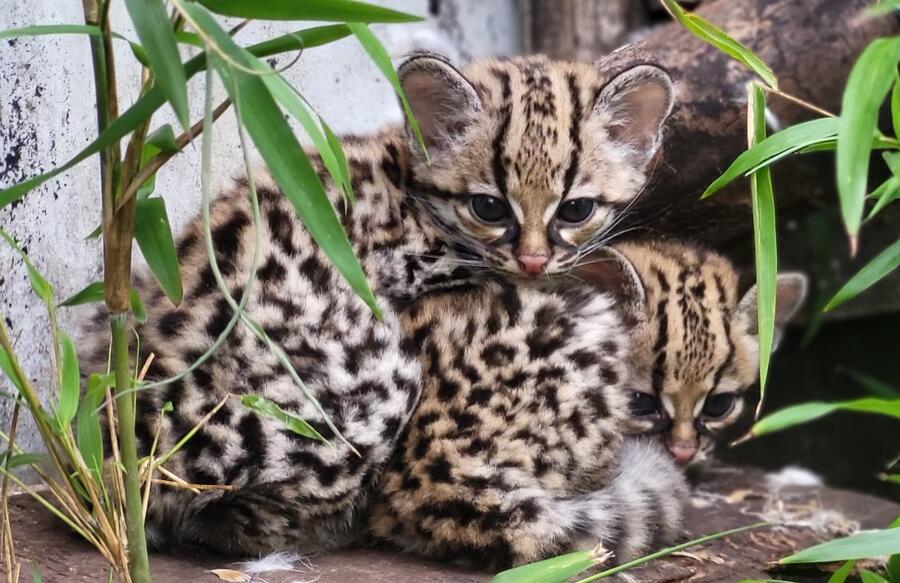

Incredibly rare Margay twins born at Welsh Mountain Zoo
Posted: 25th October, 2024Keepers at the Welsh Mountain Zoo are celebrating the incredibly rare birth of Margay kitten twins.
The super cute pair were born to mum, Sonora, and dad, Maverick, who have welcomed two single kittens previously. The Margay kittens who are yet to be named, mark a significant milestone in the Welsh Mountain Zoo’s history as the first Margay twins to be born at the Zoo.
Now a healthy twelve weeks old, the twins were both sexed as female after a recent veterinary visit confirmed that the pair are both in good health. The Zoo has had huge success in breeding Margay having welcomed some 8 kittens since 2017.
Classified as Near Threatened by the IUCN Red List the Margay is under threat in the wild largely due to deforestation of its natural habitat. Due to the Margay producing litters rarely larger than one, combined with the fact that they only reproduce once every two years in the wild, it is essential that breeding programmes in managed Zoo settings exist.
Chris Mitchell, CEO of the Welsh Mountain Zoo explained: “Whilst the arrival of one Margay kitten is cause for celebration, to welcome twins is simply wonderful. Twins are rarely born to this species, in the wild or in managed Zoo settings, and their arrival took us all quite by surprise.
“The kittens are beautiful and are developing just as we would expect in terms growth and development. They are still staying close to mum and dad but are most inquisitive and slowly beginning to explore their wider surroundings.”
The Welsh Mountain Zoo supports Margay conservation efforts via fundraising for CREA (Conservation through Research, Education, Action), a non-profit organisation designed to enhance conservation through research, education and actions. The Margay Project works to gather as much information, insight and background into the habits and behaviour of one of the world’s most elusive small cats.
Margays are semi arboreal, living both on the ground and in the trees. Research has shown that at least part of their diet is made up of prey that are strictly tree dwelling, highlighting that their use of the arboreal habitat is not merely for a safe sleeping spot but that they actively hunt there.
Related Members
-
News
 Blog: Unveiling the elusive sea life of Weymouth 19th August, 2026Even local shores are full of secrets, which is why Dr Samantha A. Hook (SEA LIFE) and her team have been uncovering the lives of skates and rays in the…
 -
News
.png?w=100&h=100&zc=1&f=jpeg&hash=d8c1f53f2c350a047de7b916ca514ca3) BIAZA Photo Competition 2026 - the winners! 18th August, 2026The wait is over! BIAZA (The British and Irish Association of Zoos and Aquariums) has announced the winners of its annual photo competition, highlighting…
BIAZA Photo Competition 2026 - the winners! 18th August, 2026The wait is over! BIAZA (The British and Irish Association of Zoos and Aquariums) has announced the winners of its annual photo competition, highlighting… -
News
.png?w=100&h=100&zc=1&f=jpeg&hash=c95bf2b49c3c10b6d10c5c3ff4406bac) Marwell Zoo holds special event to celebrate second International Scimitar-Horned Oryx Day 18th August, 2026Marwell Zoo has celebrated the second International Scimitar-Horned Oryx Day in recognition of the important conservation work it does around the world…
Marwell Zoo holds special event to celebrate second International Scimitar-Horned Oryx Day 18th August, 2026Marwell Zoo has celebrated the second International Scimitar-Horned Oryx Day in recognition of the important conservation work it does around the world…