
Fowl Play For Adopted Emu
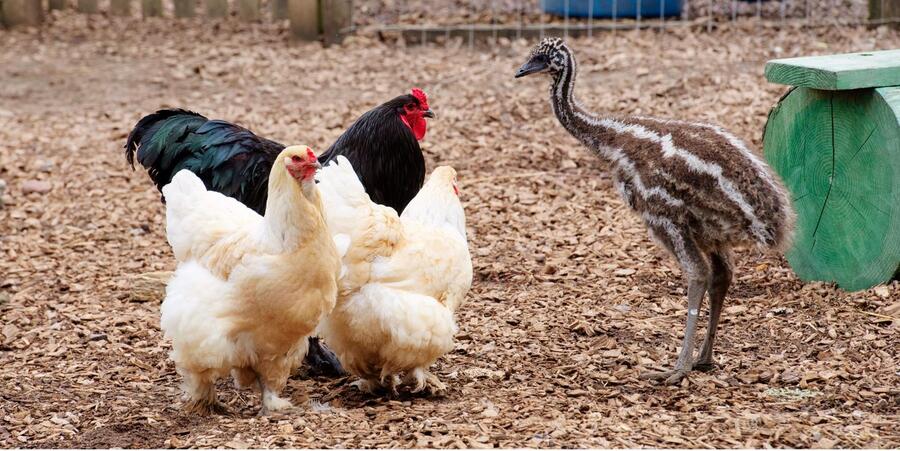
Posted: 4th August, 2021An emu chick which is having to be reared by keepers at Longleat after being rejected by its parents has made an unusual friendship with a flock of farmyard chickens.
The two-month old chick, who keepers have named Bueno, is the first to have been successfully reared at the Wiltshire safari park.
Keepers initially cared for the youngster at home, however it has now been returned to Longleat’s Family Farmyard area where it has struck up the unlikely alliance with the resident chickens.
“We decided to rear Bueno ourselves as there were signs first time mum and dad Bounty and Biscuit were not the most attentive of parents,” said keeper Gemma Short.
“As this was the first chick which had been reared here we wanted to give it as much of a chance of reaching adulthood as possible.
“Since returning to Longleat, it has settled in really well and, in addition to the chickens, it is also bonding with its adopted auntie Bourbon, an adult female emu,” she added.
If all goes well the plan is to reintroduce Bueno back to its parents once it has grown large enough to fend for itself.
Emus are among the largest birds in the world, growing in excess of two metres tall. They're found primarily in Australia, but also in New Guinea, Indonesia, Solomon Islands, and the Philippines and are part of the ratite family, along with rheas and ostriches.
Mating pairs stay together for up to five months, after which females lay large, emerald-green eggs in expansive ground nests. The males incubate the eggs for about seven weeks without drinking, feeding or leaving the nest.
Emu eggs, which are emerald green in colour, have to be incredibly tough to survive in their native Australia. The emu chick will start by pecking a hole in the egg before expanding his body to break the hard, brittle shell.
When the chicks are fully grown they can reach land speeds of up to 50 kilometres per hour making them one of the fastest land birds alongside their ostrich cousins.
Related Members
-
News
.png?w=100&h=100&zc=1&f=jpeg&hash=645fe6d42046d4da6bd442a9bf5b2715) New life at Battersea Park Children's Zoo with 20 animal births 24th July, 2026From Critically Endangered wildcat kittens to a rare first-born Patagonian mara pup, Battersea Park Children's Zoo has welcomed 20 new arrivals this…
New life at Battersea Park Children's Zoo with 20 animal births 24th July, 2026From Critically Endangered wildcat kittens to a rare first-born Patagonian mara pup, Battersea Park Children's Zoo has welcomed 20 new arrivals this… -
News
.png?w=100&h=100&zc=1&f=jpeg&hash=7001aa9607698de15099788db8bd2d5d) New Lion Trio Arrives at Belfast Zoo 24th July, 2026Belfast Zoo is delighted to announce the arrival of three young male Northern Lions, marking an exciting milestone in the Zoo’s ongoing commitment…
New Lion Trio Arrives at Belfast Zoo 24th July, 2026Belfast Zoo is delighted to announce the arrival of three young male Northern Lions, marking an exciting milestone in the Zoo’s ongoing commitment… -
News
.png?w=100&h=100&zc=1&f=jpeg&hash=715a0f0b09ee0ae1b88679895c1c6478) Blog: Navigating the job market and the workplace with a disability - my journey 22nd July, 2026Marking Disability Pride Month with Luda Balan with a personal look at navigating life, graduation, and the workforce as a disabled creator:
Blog: Navigating the job market and the workplace with a disability - my journey 22nd July, 2026Marking Disability Pride Month with Luda Balan with a personal look at navigating life, graduation, and the workforce as a disabled creator: