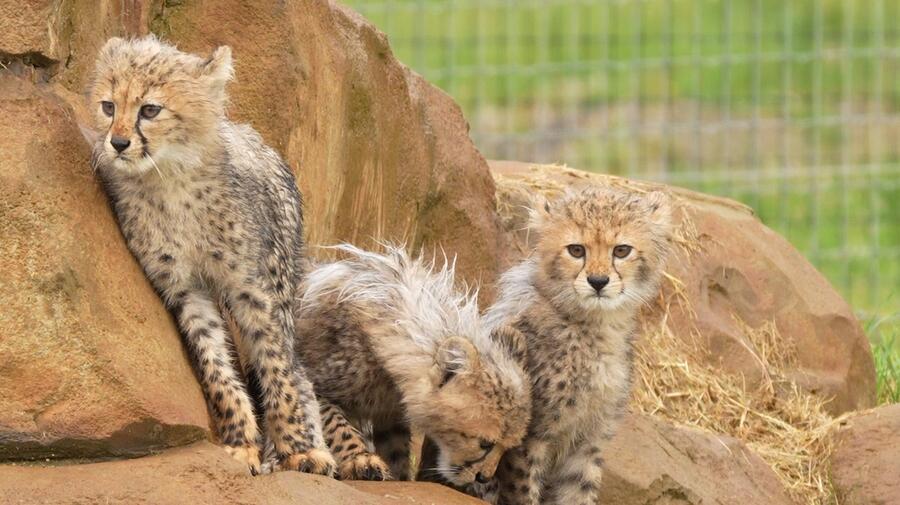
Four Endangered Cheetah Cubs at the Award-winning Yorkshire Wildlife Park have made their public debut.
Posted: 5th June, 2026The young cubs, all girls and born on Valentine’s Day, have taken their first steps into the main enclosure alongside their mother. They excitedly bounded outside for the first time and explored a cave in the reserve.
They are even more special as their parents, Brooke and Darcy, are rare Northern Cheetahs, who were introduced as part of the European Endangered Species Programme.
Director of Animals, Dr. Charlotte MacDonald, said: “It’s fantastic to see the cubs finally out and about in Cheetah Territory.
“Mum Darcy is great for both nurturing and playing with them, and it’s great to see they are so keen on exploring the enclosure’s space.”
Kate Borrington, Senior Animal Ranger at YWP, added: “The girls were a little bit cautious to start with, and a little bit nervous seeing people on the walkway, but as time has gone on, they’ve become used to it and have been running around all morning, playing with mum and each other.”
Second-time mum Darcy previously gave birth to her first litter in 2024, who were moved to Chester Zoo in late October 2025 as part of an important conservation initiative.
Kate continued: “These girls are a lot more energetic and ‘spicier’ than Darcy’s previous two, Kendi and Tafari, who were a lot more relaxed.
“They like to talk to each other. Darcy will especially be vocal to the cubs if she’s moved quite far from them and can’t see them, and vice versa. They chirp to tell each other where they are.
“It’s been super exciting from having watched the girls being born, and working with them from day one up until they’ve been out in the paddocks.
“It’s been amazing watching them grow and it’s only going to get better from here. We hope our visitors get to enjoy watching them as much as we do.
“Just like us, Darcy is super happy that the cubs are out – she’s been keen to get them out here"
Dr. Charlotte explained: “Darcy was reintroduced to our male Brooke on recommendation of the Breeding Programme. In the wild, female cheetahs are solitary and the father has nothing to do with the cubs, so Darcy remains with her cubs while Brooke is in a neighbouring reserve.”
Alongside the Cheetah cubs, visitors can discover more incredible species at the park with the recent baby boom, including a baby Titi Monkey and Okapi.
The new Titi Monkey arrival, who was born on 17th April, can be seen with its family in the same Amazonas reserve as the Park’s new Capybaras, Chip and Dale.
YWP’s Cheetah Territory covers 10,000 square metres, comprising of three reserves and two houses forming a breeding complex, which is believed to be the largest in Europe.
Kate added: “Cheetahs are under threat in the wild from habitat loss, poaching and pollution.
“They were once one of the most widespread carnivores on the planet, but are now mainly confined to Southern Africa with small numbers in East and North African and a population of less than 30 in Iran.
“We hope to continue our efforts ramping the species’ numbers up.”
The charity based at the park, The WildLife Foundation, partners with the Cheetah Conservation Fund in its mission to preserve cheetah ecosystems with interventions that are environmentally sustainable, socially responsible and economically viable.
Yorkshire Wildlife Park, which puts conservation at the heart of all its activities, offers visitors a mesmerising walk-through experience coming almost face to face with some of the world’s most beautiful and at-risk species, including Polar Bears, Black Rhinos, Giraffes and African Painted Dogs.
Related Members
-
News
.png?w=100&h=100&zc=1&f=jpeg&hash=715a0f0b09ee0ae1b88679895c1c6478) Blog: Navigating the job market and the workplace with a disability - my journey 22nd July, 2026Marking Disability Pride Month with Luda Balan with a personal look at navigating life, graduation, and the workforce as a disabled creator:
Blog: Navigating the job market and the workplace with a disability - my journey 22nd July, 2026Marking Disability Pride Month with Luda Balan with a personal look at navigating life, graduation, and the workforce as a disabled creator: -
News
.png?w=100&h=100&zc=1&f=jpeg&hash=8e9c4f781070ade5a9e110a614e99e44) Blog: When Dublin Zoo celebrated a first-ever participation in Dublin Pride 17th July, 2026In June, Dublin Zoo donned Pride regalia and joined the celebrations for the first time. Dr Andrew Mooney (Conservation and Science Manager, Dublin Zoo)…
Blog: When Dublin Zoo celebrated a first-ever participation in Dublin Pride 17th July, 2026In June, Dublin Zoo donned Pride regalia and joined the celebrations for the first time. Dr Andrew Mooney (Conservation and Science Manager, Dublin Zoo)… -
News
.png?w=100&h=100&zc=1&f=jpeg&hash=95fa6b2703c57d7d96987f15128f9072) Bristol Zoo Project launches global search for Critically Endangered fish's perfect match 17th July, 2026Bristol Zoo Project has launched a global search to find a match for a Critically Endangered Cameroon cichlid after discovering that just one individual…
Bristol Zoo Project launches global search for Critically Endangered fish's perfect match 17th July, 2026Bristol Zoo Project has launched a global search to find a match for a Critically Endangered Cameroon cichlid after discovering that just one individual…