
Endangered red panda family grows with birth of twins at Whipsnade Zoo
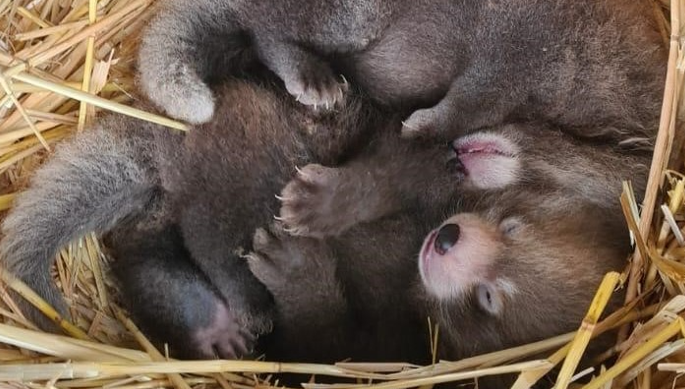
Posted: 3rd August, 2023One-month-old twin red pandas curl up in their cosy nest box at Whipsnade Zoo, as keepers celebrate their birth as part of a European breeding programme for the Endangered species.
Born at the conservation zoo on Sunday 25 June to mum Ruby and dad Nilo, the tiny pair each weighed just 113g at birth - roughly the same weight as a banana - and have not yet ventured out from the straw-filled nest, where zookeepers say they are being expertly cared for by their first-time parents.
Zookeeper Grant Timberlake said: “We suspected Ruby was pregnant and wanted to do everything we could to make her first experience as a mum a smooth one, so we were ecstatic when we spotted her curled up in one of the nesting boxes we had prepared, using her bushy red tail to keep the two cubs warm.
“Ruby has been doing an incredible job feeding and caring for the twins, so we’re leaving the family to bond together, only checking in on them when she pops outside to eat.”
Red panda (Ailurus fulgens) cubs are blind for the first 30 days of their lives, and heavily reliant on their mothers. The cubs will soon open their eyes but won’t venture outside for at least another month; in the meantime, visitors to the conservation zoo can look out for Nilo climbing his favourite oak tree or Ruby snacking on her favourite bamboo.
“Red pandas can be difficult to spot due to their shy nature, their nocturnal habits and the fact that they spend most of their time up trees - or in this case snuggled up inside a tree stump. We might not see much of Ruby and Nilo’s babies for the first couple of months of their lives, but they’ll be worth the wait when they come outside and start to explore. And in the meantime, we have these incredible pictures, charting their start to life.”
The cubs won’t be named until they receive their first vet check at eight-weeks-old, when the team will discover if they are male or female. Whatever their sex, the twins are of international significance, as a boost to the red panda population.
Grant explained: “These twin cubs give us double hope for the species, as they were born as part of an important European breeding programme for Endangered red pandas, designed to keep a healthy and genetically diverse back-up population safe in conservation zoos - while we tackle the issues they’re facing in the wild.
“Red pandas hail from the Himalayan mountains of Nepal, Myanmar and India, as well as forests in Western China, where they are threatened by habitat loss, a decline in their main food source - bamboo - as well as poaching for the illegal pet, meat and medicine trade.”
ZSL - the international conservation charity behind Whipsnade Zoo - is working in the Terai Arc Landscape, an area which spans both Nepal and India, to prevent the illegal wildlife trade, which has led to declines in Endangered red panda, Asian elephant and Bengal tiger populations. ZSL conservationists have helped to train more than 400 rangers, build guard posts and watchtowers, and install surveillance equipment to monitor these threatened species.
Visit Whipsnade Zoo this summer to see Ruby and Nilo and more than 11,000 other animals at the UK’s largest zoo. Every ticket supports ZSL’s vital science and conservation work around the globe. To book, visit: www.whipsnadezoo.org
Related Members
-
News
.png?w=100&h=100&zc=1&f=jpeg&hash=d8c1f53f2c350a047de7b916ca514ca3) BIAZA Photo Competition 2026 - the winners! 13th August, 2026The wait is over! BIAZA (The British and Irish Association of Zoos and Aquariums) has announced the winners of its annual photo competition, highlighting…
BIAZA Photo Competition 2026 - the winners! 13th August, 2026The wait is over! BIAZA (The British and Irish Association of Zoos and Aquariums) has announced the winners of its annual photo competition, highlighting… -
News
.png?w=100&h=100&zc=1&f=jpeg&hash=326487f1d57ac0eab876b8e79d153670) Accessibility on a Budget: what we've learned at Shaldon Wildlife Trust 11th August, 2026As the zoo which won the 2026 BIAZA Accessibility in Action Award (in partnership with Agility Marketing) Shaldon Wildlife Trust’s Anna Cowen-Hubbard…
Accessibility on a Budget: what we've learned at Shaldon Wildlife Trust 11th August, 2026As the zoo which won the 2026 BIAZA Accessibility in Action Award (in partnership with Agility Marketing) Shaldon Wildlife Trust’s Anna Cowen-Hubbard… -
News
.png?w=100&h=100&zc=1&f=jpeg&hash=b980abd5e6f56a95d9119ccc5a64b796) Thriving Together: Animal Welfare Assessment Across BIAZA Organisations 6th August, 2026In this week's blog, the BIAZA Animal Welfare Working Group details how welfare assessments benefit not only the animal, but staff and organisations…
Thriving Together: Animal Welfare Assessment Across BIAZA Organisations 6th August, 2026In this week's blog, the BIAZA Animal Welfare Working Group details how welfare assessments benefit not only the animal, but staff and organisations…