Blog: Towards the development of sustainable coral reef fish collections
Posted: 13th January, 2022Bangor University's Dr Nick Jones & Dr Tom Galley tell us about their incredible project to enhance the reproduction of coral reef fish in aquariums
As the world’s aquatic species face increasing threats due to climate change, overfishing and pollution, public aquariums together with commercial producers and scientific researchers from around the world are leading the way in developing methods for breeding and rearing coral reef fish for the aquarium community. Ultimately, this will equip scientists with the knowledge to rear more endangered species, at a time where biodiversity is rapidly declining. As this research is difficult, if not impossible to undertake in the wild, public aquariums provide an invaluable research platform.
Aquarists from ZSL (Zoological Society London), The Deep and SEA LIFE have teamed up with us at Bangor University’s School of Ocean Sciences on an exciting and innovative research project to improve our understanding of the reproductive biology and life cycle requirements of coral reef fishes. The goal of the SustaiNable Aquariums project (SNAP), which is part-funded by the European Regional Development Fund through the Welsh Government’s SMARTExpertise programme, is to develop protocols and technology for breeding and rearing a wide variety of coral reef fish species. Coral reef ecosystems are biodiversity hot spots, this important research supports and adds another sustainability tool that can be used by aquaria.
Aquacultured coral reef fish raised in hatcheries are widely recognised as having advantages over counterparts, such as being pre-adapted to specialist husbandry techniques and diets used in aquaria. However, the rigorous research needed to complete the life cycle of many of these species in a hatchery setting is a particularly challenging and lengthy process that can take several years.
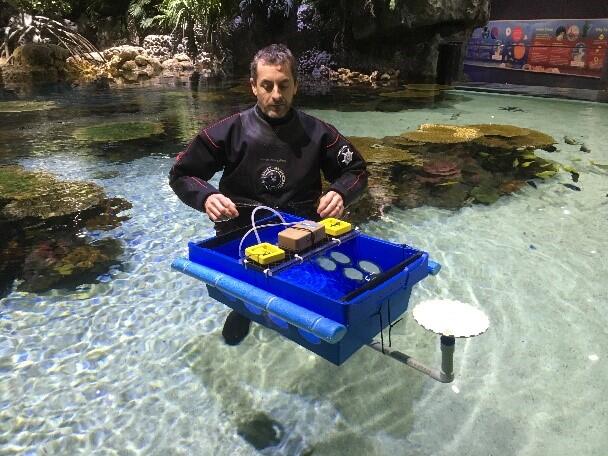
Eggs spawned on either hard surfaces, or directly into the water column, are collected from display aquariums at eleven public aquarium sites across the UK and transported to Bangor University where we attempt to rear their larvae. The difficulty in rearing most coral reef fish lies in the incredibly small size of their delicate larvae (most less than 3mm in length at hatch), a limited understanding of appropriate larval rearing environments, plus the need to offer suitably sized and nutritious food items. These are issues we are working hard to resolve during the project, which finishes in 2022. Added to this, some species have particularly long larval phases, meaning that they require significant levels of care and attention over a prolonged period of time.
To date, we have reared and returned over 750 fish (from three damselfish species) for display at public aquariums, with many more on the way. Additionally, considerable progress has also been made towards the rearing of wreckfish, dwarf angelfish and dartfish species, with further work planned with other species of coral reef fish next year.
Projects like SNAP advance aquaculture techniques and further our understanding of the reproductive biology of coral reef fishes, while highlighting the collective awareness that aquariums have an important role to play in the future of conserving our oceans.
Follow our progress on Twitter (@SNAP_EU) and Facebook (SustaiNable Aquariums Project – SNAP)
Dr Nick Jones & Dr Tom Galley
School of Ocean Sciences, Bangor University
All blogs reflect the views of their author and are not a reflection of BIAZA's positions.
-
News
.png?w=100&h=100&zc=1&f=jpeg&hash=326487f1d57ac0eab876b8e79d153670) Accessibility on a Budget: what we've learnt at Shaldon Wildlife Trust 11th August, 2026As the zoo which won the 2026 BIAZA Accessibility in Action Award (in partnership with Agility Marketing) Shaldon Wildlife Trust’s Anna Cowen-Hubbard…
Accessibility on a Budget: what we've learnt at Shaldon Wildlife Trust 11th August, 2026As the zoo which won the 2026 BIAZA Accessibility in Action Award (in partnership with Agility Marketing) Shaldon Wildlife Trust’s Anna Cowen-Hubbard… -
News
.png?w=100&h=100&zc=1&f=jpeg&hash=b980abd5e6f56a95d9119ccc5a64b796) Thriving Together: Animal Welfare Assessment Across BIAZA Organisations 6th August, 2026In this week's blog, the BIAZA Animal Welfare Working Group details how welfare assessments benefit not only the animal, but staff and organisations…
Thriving Together: Animal Welfare Assessment Across BIAZA Organisations 6th August, 2026In this week's blog, the BIAZA Animal Welfare Working Group details how welfare assessments benefit not only the animal, but staff and organisations… -
News
 BIAZA calls for native species projects for Great British Wildlife Restoration 3rd August, 20263 August 2026 The Great British Wildlife Restoration Awards by the British and Irish Association of Zoos and Aquariums (BIAZA) is looking for Britain’s…