Belfast Zoo welcomes endangered giraffe calf to the herd
Posted: 2nd August, 2022An endangered Rothschild’s giraffe was born at Belfast Zoo on Sunday 24 July 2022.
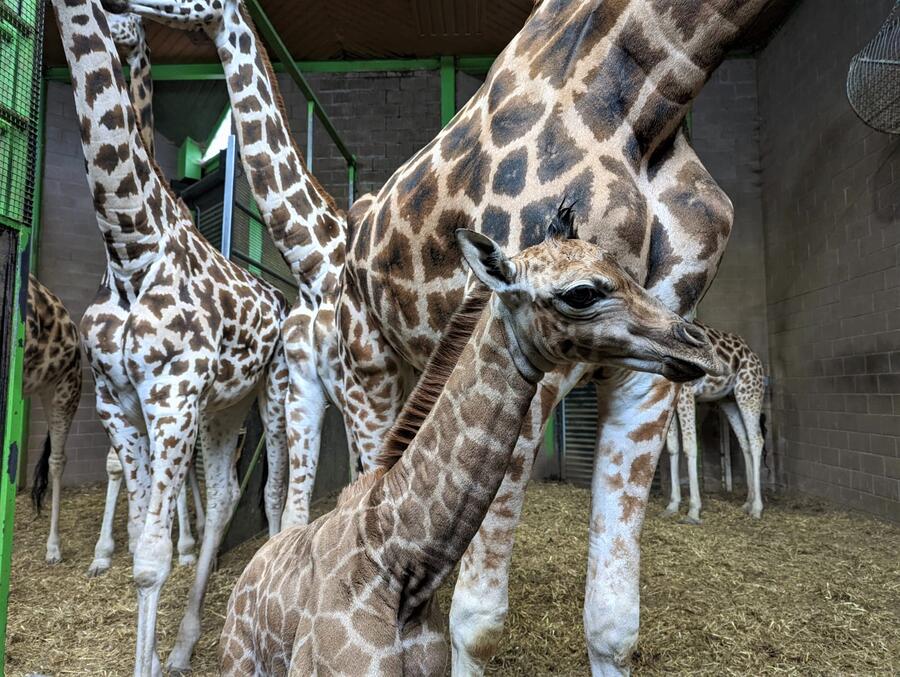
Proud mum, Casey, laboured for two hours and gave birth naturally at 2.30pm, inside the giraffe house, which was closed to the public to provide privacy for bonding. Zookeepers report that the male calf is doing well and that Casey is doing a great job. Casey is a second time mum, after giving birth to Ballyronan in May 2020.
Belfast Zoo traditionally names giraffes after places beginning with “Bally”. The male Rothschild’s giraffe calf is named Ballyhenry, a townland in County Antrim, which was chosen by Curator Raymond Robinson.
New-born giraffes usually weigh around 100kg and are around 5 feet 9 inches tall, but little Henry measures 5 feet 7inches. Rothschild’s giraffes are one of the most endangered giraffe subspecies. Estimates suggest that only around 2,000 remain in the wild, due to illegal hunting for meat and hide and a continuing loss of habitat.
Sustained conservation action has helped the general giraffe population move from ‘endangered’ status to ‘near threatened’ on the International Union for Conservation of Nature (IUCN) Red List, but the Rothschild’s giraffe subspecies remains endangered.
Alyn Cairns, Zoo Manager, said “We’re delighted to welcome little Henry to the herd at Belfast Zoo. We first welcomed Rothschild’s giraffes in 1988 and have since celebrated the birth of 39 calves. We’re proud to participate in a European breeding programme and collaborate with zoos around the world. Our breeding success helps to ensure that that there is a ‘safety net’ population of this endangered subspecies.”
Related Members
-
News
.png?w=100&h=100&zc=1&f=jpeg&hash=645fe6d42046d4da6bd442a9bf5b2715) New life at Battersea Park Children's Zoo with 20 animal births 24th July, 2026From Critically Endangered wildcat kittens to a rare first-born Patagonian mara pup, Battersea Park Children's Zoo has welcomed 20 new arrivals this…
New life at Battersea Park Children's Zoo with 20 animal births 24th July, 2026From Critically Endangered wildcat kittens to a rare first-born Patagonian mara pup, Battersea Park Children's Zoo has welcomed 20 new arrivals this… -
News
.png?w=100&h=100&zc=1&f=jpeg&hash=7001aa9607698de15099788db8bd2d5d) New Lion Trio Arrives at Belfast Zoo 24th July, 2026Belfast Zoo is delighted to announce the arrival of three young male Northern Lions, marking an exciting milestone in the Zoo’s ongoing commitment…
New Lion Trio Arrives at Belfast Zoo 24th July, 2026Belfast Zoo is delighted to announce the arrival of three young male Northern Lions, marking an exciting milestone in the Zoo’s ongoing commitment… -
News
.png?w=100&h=100&zc=1&f=jpeg&hash=715a0f0b09ee0ae1b88679895c1c6478) Blog: Navigating the job market and the workplace with a disability - my journey 22nd July, 2026Marking Disability Pride Month with Luda Balan with a personal look at navigating life, graduation, and the workforce as a disabled creator:
Blog: Navigating the job market and the workplace with a disability - my journey 22nd July, 2026Marking Disability Pride Month with Luda Balan with a personal look at navigating life, graduation, and the workforce as a disabled creator: