
Battersea Park Children's Zoo supporting action against invasive Asian hornets
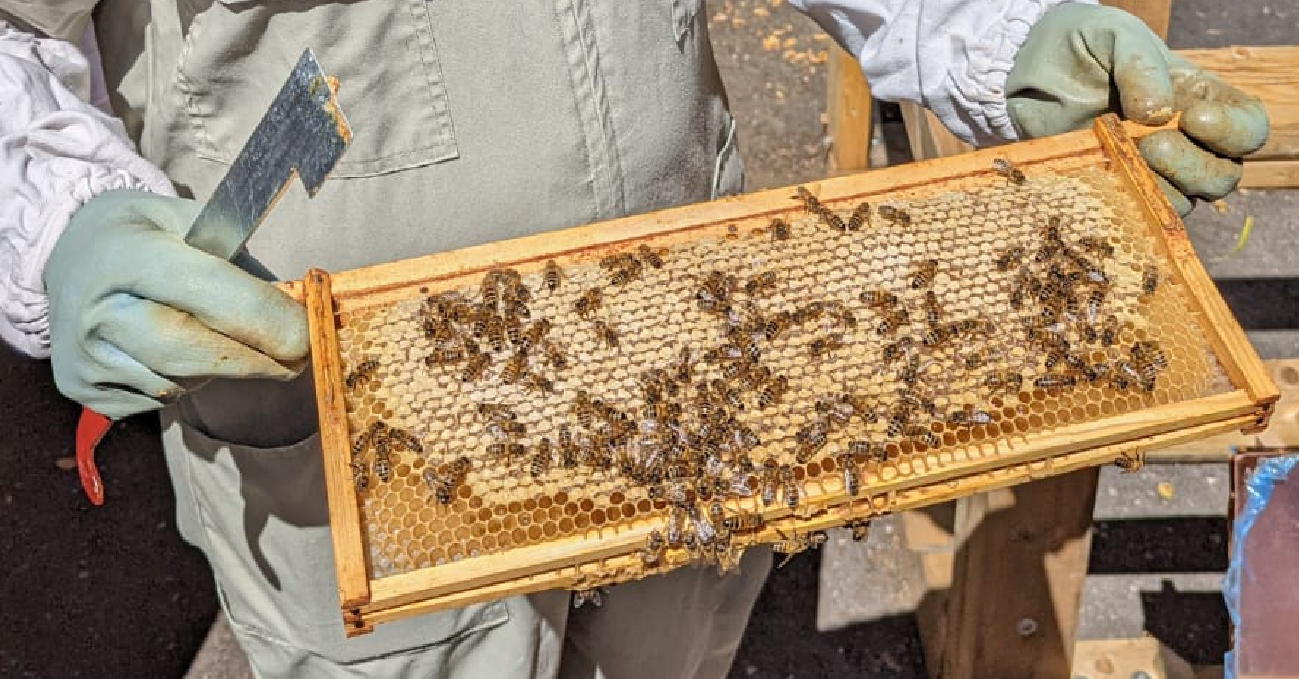
Posted: 11th September, 2023Yesterday, 10th September Battersea Park Children's Zoo hosted an emergency meeting of the London Beekeepers Association regarding the increasing threat of Asian Hornets to our native pollinators and honey bees.
BPCZ Animal Manager Jamie Baker and beekeeper Annie McGeoch from the London Beekeepers Association and the BBKA - The British Beekeepers Association is calling on the public to help fight a major threat to our native pollinators and honey bees - Asian hornets.
Numbers of this invasive, destructive insect have risen rapidly this summer and more have been detected in the UK this year than in the previous six years combined. The BBKA aims to raise awareness of the Asian hornet as the species could decimate our pollinators including our honeybees.
It is important for everyone to be actively looking for them, and If you spot an Asian hornet, please report it by using the ‘Asian Hornet Watch’ app available free on both Android and iphone. Use this handy guide below to ensure you correctly identify this invasive insect, which can look similar to our native European hornet.
For more information on identifying Asian hornets and why it is vital they don’t spread across the country, visit this link to the BBKA website. https://www.bbka.org.uk/listing/category/asian-hornet-vespa-velutina
Related Members
-
News
.png?w=100&h=100&zc=1&f=jpeg&hash=eb7aeb58df1e2020f5831fab9bcbd3c4) Blog: Building Inclusion through Irish Sign Language at Dublin Zoo 30th July, 2026Amy Horace (Customer Service Supervisor, Dublin Zoo) on implementing ISL in the zoo, and how sign language schemes can benefit the the wider BIAZA community:…
Blog: Building Inclusion through Irish Sign Language at Dublin Zoo 30th July, 2026Amy Horace (Customer Service Supervisor, Dublin Zoo) on implementing ISL in the zoo, and how sign language schemes can benefit the the wider BIAZA community:… -
News
.png?w=100&h=100&zc=1&f=jpeg&hash=a59e107ab01361799467defae3ac8045) Near-extinct snails hatched at UK zoo have returned to the wild following major conservation breeding success 30th July, 2026Conservationists have just reintroduced hundreds of tiny snails on a rocky Atlantic island after a zoo breeding programme pulled four species back from…
Near-extinct snails hatched at UK zoo have returned to the wild following major conservation breeding success 30th July, 2026Conservationists have just reintroduced hundreds of tiny snails on a rocky Atlantic island after a zoo breeding programme pulled four species back from… -
News
.png?w=100&h=100&zc=1&f=jpeg&hash=645fe6d42046d4da6bd442a9bf5b2715) New life at Battersea Park Children's Zoo with 20 animal births 24th July, 2026From Critically Endangered wildcat kittens to a rare first-born Patagonian mara pup, Battersea Park Children's Zoo has welcomed 20 new arrivals this…
New life at Battersea Park Children's Zoo with 20 animal births 24th July, 2026From Critically Endangered wildcat kittens to a rare first-born Patagonian mara pup, Battersea Park Children's Zoo has welcomed 20 new arrivals this…